Arizona
On the RoadArizona is a recurring waypoint in the journeys west and south: its desert roads and mountain passages test the travelers’ resources, while its landscapes repeatedly enlarge the promise of movement. The state is not simply open space to cross. A stop in Tucson supplies the money needed to continue, and the later approach through Arizona turns the road into a threshold between the familiar United States and Mexico.
Routes Through the State
Arizona enters the westbound itinerary as a destination glimpsed from afar and then as part of a route shaped by changing terrain. On a return bus journey from Hollywood, the road crosses the Arizona desert at dawn, passes Flagstaff and its cliff towns, and then swings north toward New Mexico. The traveler prefers the landscape itself to the book he is carrying, finding that every rise and stretch intensifies his longing. Arizona is thus encountered in motion: a succession of terrain and direction rather than a settled home.
The later drive toward Tucson comes by way of Las Cruces, New Mexico. At dawn, the travelers wake in the mountains with steamed-up car windows obscuring their location. Outside, the scene opens onto purple air, red mountainsides, green valley pastures, dew, gold-lit clouds, gopher holes, cactus, and mesquite. With the others asleep, Sal takes the wheel and descends with the clutch in and engine off to save gas, rolling into Benson. The striking landscape and the improvised economy of the descent belong to the same episode: Arizona offers both expansive beauty and a practical problem of making the remaining fuel last.
Tucson as a Stop for Help
Tucson is where a promise of assistance becomes immediate support. The travelers have agreed to take a hitchhiker as far as San Francisco, but they lack the money to continue as planned. Sal remembers that his old friend Hal Hingham lives in Tucson and may lend him five dollars; Dean promptly redirects the journey there. Once in town, they find Hingham at his home on Fort Lowell Road, in the flat desert among riverbed trees.
The stop brings the hungry party into Hingham’s household. He is a writer who came to Arizona to work on a book in peace; his wife and baby are with him in a small adobe house built by his Native American stepfather, while Hingham’s mother lives across the yard. She invites the visitors into her kitchen, where they cook noodles in a large pot. The assistance is not abstract: after the meal, Hingham cashes a five-dollar check and gives Sal the money. Tucson becomes a point where friendship, hospitality, food, and cash briefly interrupt the pressure of the road.
The Road’s Changing Scale
Arizona also belongs to a larger geography of movement. On another westbound crossing, the travelers go over Berthoud Pass, descend to the plateau, and continue through Colorado toward the Colorado–Utah border. The desert clouds seem to offer a direction onward, while the travelers’ attention catches on abandoned covered wagons, pool tables, roadside stands, and weathered signs in the Nevada desert. In Salt Lake City, the two drivers check on their girls before continuing west. Arizona is not named in this stretch, but the state’s earlier desert crossing and Tucson stop form part of the same westward pattern: routes and resources connect places that the narrative also makes into images of the continent’s scale.
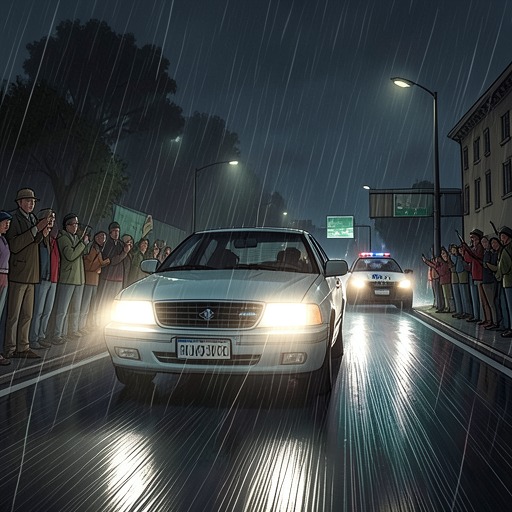
The state’s position changes when the travelers turn south. After crossing into Arizona at dawn, the group stops in Benson to pawn Sal’s four-dollar pocket watch for a dollar of gasoline. A trooper appears as they are about to leave and demands the driver’s license; Dean and Marylou have been asleep together under a blanket, and the papers are in order. The encounter ends without arrest, and they drive on to Tucson. The sequence makes the road’s freedom visibly dependent on money, documents, fuel, and the ability to keep moving.
Landscape and Threshold
Arizona’s landscapes recur as thresholds rather than destinations. The night drive toward the state gives way to a vivid mountain sunrise; the Tucson visit converts a personal connection into enough money for the next leg; and the later dawn crossing out of Laredo brings the travelers into a Mexican desert that they experience as a new phase beyond what they have known. The language of open space can make the road seem limitless, but the episodes in Arizona give that promise material conditions: a borrowed five dollars, a pawned watch, a carefully conserved gallon of gas, and a household willing to feed strangers.
The state consequently holds together two scales of the book’s road narrative. It is specific ground, with named towns, a desert city, mountain roads, and a friend’s home; it is also a passage through which the travelers repeatedly imagine the West as movement toward something farther on. Its importance lies in that tension: Arizona widens the view, but its journeys advance only through practical exchanges and precarious decisions.